
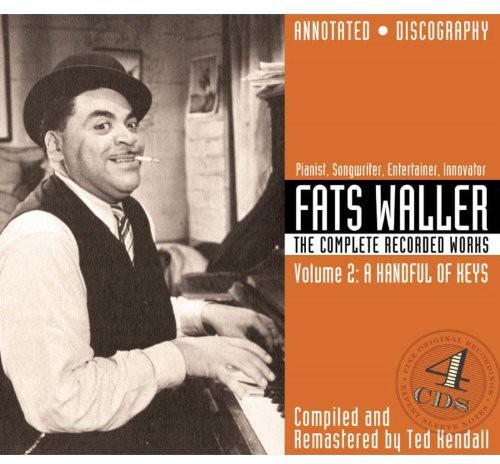
1
Handful of Keys
2
Minor Drag, The
3
Harlem Fuss
4
Numb Fumblin'
5
Ain't Misbehavin'
6
Sweet Savannah Sue
7
I've Got a Feeling I'm Falling
8
Love Me or Leave Me
9
Gladyse
10
Valentine Stomp
11
Waiting at the End of the Road
12
Baby, Oh! Where Can You Be?
13
Tanglefoot
14
That's All
15
Waitin' at the End of the Road
16
Baby, Oh! Where Can You Be?
17
Goin' About
18
My Feelin's Are Hurt
19
That's How I Feel Today
20
Six or Seven Times
21
Smashing Thirds
22
Lookin' Good But Feelin' Bad
23
I Need Someone Like You
24
Big Business Pt. 1
25
Big Business Pt. 2
26
I Wish I Were Twins
Item UPC: 788065902827
Date First Available:
Label: JSP
ABOUT THE ALBUM
By 1929, aged 25, when this compilation opens, Fats had established himself among the inner circle of New York session players; with Andy Razaf he was getting into his stride as a songwriter; he was a recording artist; he had contributed to a couple of hit Broadway shows; he had played Carnegie Hall. The opening track show Fats as a gifted soloist and as an inspiring bandleader. Handful Of Keys has Fats in his stride-influenced glory, dazzling with what Jelly Roll Morton called a 'picture-show' right hand. Ain't Misbehavin' was written for the 1929 revue 'Hot Chocolates'. As well as consolidating Louis Armstrong's showbiz career, it established Waller/Razaf as a leading writing team. There are some of Fats' distinctive organ numbers here. Victor had bought a church in Camden to use as a studio. The church came with it's own organ which was familiar to Fats. He had used it for his first Victor cut in 1926. Few players in the prewar years could produce such authentic jazz from the instrument. At the end of the 'Roaring Twenties' came the Stock Market crash. Few escaped. The recording industry was no exception. Victor had sold about 35 million discs in 1929. In 1930, sales were half that, and in 1931 they were 3 million. The situation could have been serious for Fats - but that would be to underestimate his selling power. He cut only two sessions in 1930, but that was as slow as his recording career ever got. Fats' irrepressible personality was made for radio and live performance. That's part of the story. He was now writing his own scintillating material. This might have been because he was so often asked to record inferior work written by others. The problem was, even when he was given below-standard writing he was able by some alchemy to turn it into gold. The evidence here - if it was ever needed - is that Fats never cut a dud side.
Check out these titles

Deadbeat
Tame Impala
The Monument Singles Collection 1964-1968
Dolly Parton

Buzzkill (Rsd)
Locustz

Live At Easy Street Records Vol II
Brandi Carlile

Adam
Adam Lambert
A-Meow-Zing Music
Gabby's Dollhouse: The Movie / O.S.T.

The Age of Everything
Johnny Marr
Doomnuts (purple Vinyl)
J Dilla & Mf Doom & J Villain

Suicide Season
Bring Me The Horizon
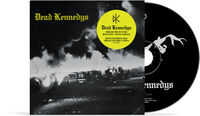
Fresh Fruit For Rotting Vegetables - 2026 Remaster
Dead Kennedys

