
1
Now I Got the Blues
2
Don't Ration My Love
3
Mistake in Life
4
Grinder Man Blues
5
Slim's Boogie
6
Little Mary
7
Cheatin' Around
8
Letter Home, A
9
Kilroy Has Been Here
10
Rockin' This House
11
Lend Me Your Love
12
Darling I Miss You
13
Pacemaker Boogie
14
(Sometimes I Feel Like A) Motherless Child
15
Harlem Bound
16
Life Is Like That
17
Nobody Loves Me
18
Believe I'll Settle Down
19
Throw This Poor Dog a Bone
20
Help Me Some
21
Country Girl
22
Blue and Lonesome
23
Angel Child
24
Midnight Jump
25
Messin' Around
26
Call Me Before You Go Home
Item UPC: 788065776220
Date First Available:
Label: JSP RECORDS
ABOUT THE ALBUM
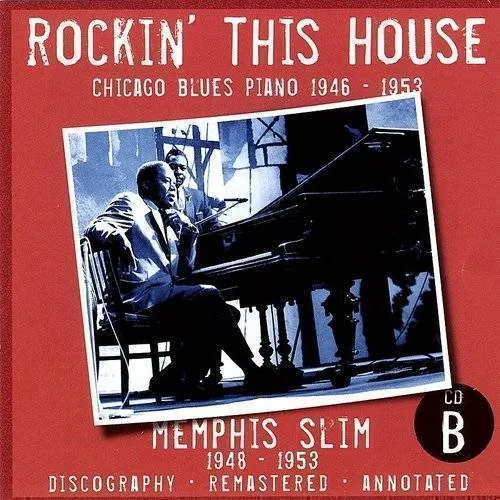
Chicago blues pianists ruled the roost in the taverns where blues was played, and when rent parties were thrown. They'd work all night for food and drink. It was an ideal environment for Peter Chatman, who got to Chicago in 1937. He was born John L. Chatman in Memphis, TN in 1915. His father was a Baptist deacon. He was the great-nephew of Mississippi Sheiks Lonnie and Sam Chatmon. Aged seven the boy began to emulate the pianists who played next door for weekend parties. His idol was Roosevelt Sykes. When Sykes went north in 1931, John replaced him at the Midway Cafe. At 22, he upped to Chicago. Over the next three years, he wove himself into the blues fraternity. Eventually, Big Bill Broonzy asked him to play at his sessions. Within three months (and three days before Pearl Harbor) he was recording for Bluebird - as Memphis Slim. He didn't record again until spring 1946 - some say it was the first postwar Chicago blues session. Sometime before March 16th, Slim cut eight songs. These were issued on Hi-Tone. Slim was joined by Cozy Eggleston on tenor sax and Ernest 'Big' Crawford on bass. Then he signed with the Hollywood Rendezvous. Another session was cut. With these records, Slim announced his arrival as a bandleader of merit. It began to be apparent when he signed with Miracle towards the end of 1946, with a band that consisted of two horns and a bassist and went by the name of the House Rockers. The absence of a drummer on some cuts was more than compensated by Willie Dixon's driving rhythm. Memphis Slim and his House Rockers continued to make a stream of good contemporary blues through to the end of the decade, including Messin' Around, a number that became part of his long-term repertoire. Memphis Slim's star never waned. In 1962, after a series of successful European tours, he relocated to Paris, where he remained - busy to the end.
Check out these titles
Fire From The Hip
Finn Wolfhard
A-Meow-Zing Music
Gabby's Dollhouse: The Movie / O.S.T.

Daughter From Hell
Gracie Abrams

I'm So Happy
Ms. Rachel

Trespasser
Grace Potter
bones
Rainbow Kitten Surprise
The Age of Everything
Johnny Marr
Bluegrass Women
Lindsay Lou
GREENGREEN
Cortis

Embers to Ashes
Everlast

