
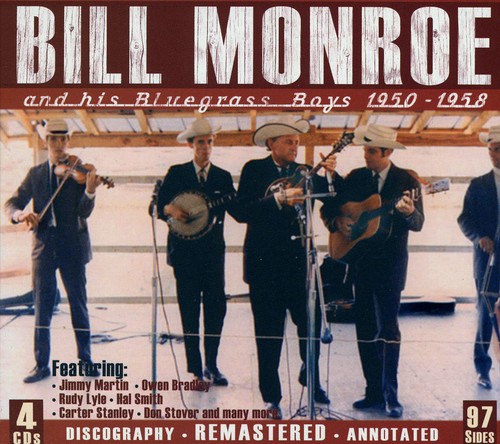
1
Blue Grass Ramble
2
New Mule Skinner Blues
3
My Little Georgia Rose
4
Memories of You
5
I'm on My Way to the Old Home
6
Alabama Waltz
7
I'm Blue, I'm Lonesome
8
I'll Meet You in Church Sunday Morning
9
Boat of Love
10
Old Fiddler, The
11
Uncle Pen
12
When the Golden Leaves Begin to Fall
13
Lord Protect My Soul
14
River of Death
15
Letter from My Darling
16
On the Old Kentucky Shore
17
Raw Hide
18
Poison Love
19
Kentucky Waltz
20
Prisoner's Song
21
Swing Low Sweet Chariot
22
Angels Rock Me to Sleep
23
Brakeman's Blues
24
Travelin' Blues
Item UPC: 788065711924
Date First Available:
Label: JSP
ABOUT THE ALBUM
By 1950, when this collection opens, Bill Monroe was a longterm star. He had thrived in the Depression and had enhanced his reputation during and after WW2. His great claim to fame was as the creator of Bluegrass. Our earlier set of Bill Monroe material (JSP 7712) featured his recordings up to late 1949. This second volume covers the era when he met the threat of rock 'n' roll. The mature star is featured here - all his virtuosity and vigor evident. His band members include masters like Rudy Lyle and Jimmy Martin and stars of the quality of Carter Stanley (briefly separated from Ralph) and Don Stover. Included too, are the sides that Monroe recorded as a tribute to Jimmie Rodgers. They divide opinion - some regard them as an aberration, others as a pointer to the future of Bluegrass. Cutting records was just part of the Monroe schedule. He was almost permanently on tour. Like most of his peers, he travelled between dates by car. In January 1953 he, and his companion, Bessie Lee Mauldin, were on the road to Nashville. At around 3 am an oncoming vehicle hit them. Bessie Lee received minor injuries but Bill had around nineteen broken bones. Incredibly he got out of the car, pulled Bessie free and got them both off the road. Bill was in hospital for three months. By May he was back on tour. His life then took a turn for the better. Elvis Presley's version of Blue Moon Of Kentucky rode high on the charts. Songwriting royalties were the result. And he still had a regular Opry spot. With the 1960s came new interest in folk roots and an upward surge in Bill's career. He continued to record and perform up until shortly before his death in 1996. By then he'd performed for four American presidents. It's no surprise that he was a national treasure
Check out these titles

Trespasser
Grace Potter

The Dark
Chelsea Wolfe
Greatest Hits - Deluxe Edition
Fleetwood Mac
Long Bed
Post Malone
The Monument Singles Collection 1964-1968
Dolly Parton
SURFILMUSIC (Soundtrack & 4-Tracks)
Jack Johnson

Rockstar
Dolly Parton
Days
Mountain Goats
Deadbeat
Tame Impala

Yearning: The Unbeautiful After
Boundaries

