
1
Dad Gum Ya Hide, Boy!
2
Whiskey Do Your Stuff
3
Gal, You Need a Whippin'!
4
Time's A-Passin'
5
It's Hard to Be Good Without You
6
Dripper, The
7
Ooo-Wee
8
I Seen What'cha Done
9
Fat Back and Corn Liquor
10
Put Some Money in the Pot, Boy, 'Cause the Juice Is Runnin' Low
11
Private Property (No Trespassing)
12
Gotta Go
13
Messy Bessy
14
Louie's Blues
15
I'll Die Happy
16
If I Had Any Sense, I'd Go Back Home
17
Hurry Home
18
Dollar Down, A
19
Yeah, Yeah, Baby!
20
It's Been Said
21
Whatever Lola Wants (Lola Gets)
22
Slo', Smooth and Easy
23
Bananas
24
Baby, Let's Do It Up!
25
Chicken Back
26
Baby, You're Just Too Much!
27
Where Can I Go
28
Rock 'n' Roll Call
Item UPC: 788065420727
Date First Available:
Label: JSP RECORDS
ABOUT THE ALBUM
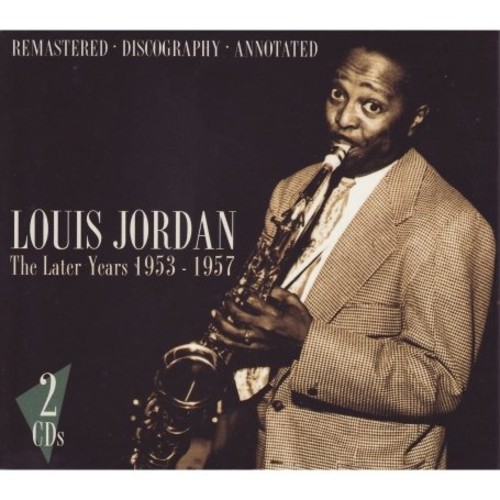
Throughout the 1940s, singer/saxist Louis Jordan had been a phenomenon. Between 1942 and 1951, he had 55 Top Ten hits, some of which were 'crossovers'. Louis was born in on July 8, 1908. Well versed in music from an early age, his father James was the leader of a local band. In the 1920s, father and son joined a minstrel troupe, which also included a young Homesick James. 'We'd put up a tent. It was like a carnival then, ' James later said. At college in Little Rock, Louis took jobs with a number of bands. In 1932 he got together with Ida Fields, a hoofer from Texas. Then he turned up in Philadelphia, where he met trumpeter Charlie Gaines. In March 1934, the pair cut 'I Can't Dance, I Got Ants In My Pants' in New York. In the summer of 1936 Louis joined Chick Webb's band, which featured Ella Fitzgerald. He cut two sessions with Webb, where he took the chance to sing. He tried to recruit Fitzgerald to his own outfit and Webb sacked him. Louis got a residency at Harlem's Elks Rendezvous Club and a contract with Decca. There followed a decade of almost continuous hits. By the end of the 1940s, Jordan's star was waning, but his career was dealt a blow by what became Rock 'n' Roll. Worse, the leading exponent of the new music - Bill Haley - was mentored by Jordan's old manager, Milt Gabler. He was always bitter about this - but he still made some great music. He moved from label to label, seeking a return to his earlier success. Signing a contract with Mercury enabled him to revisit some of his hits, re-arranged to make them more palatable to a younger rock-oriented audience. Eleven oldies were laid down in October 1956, from which two singles were released, the second containing 'Big Bess' and 'Cat Scratchin' - new songs that might have done better. Despite Mercury's obvious enthusiasm, little found favor with the public. But fifty years on, we can see that the quality of these last efforts is greater than their original fate implied.
Check out these titles

Siamese Dream (RSD Essential) -
Smashing Pumpkins
son of dad
Stephen Wilson Jr.

The Age of Everything
Johnny Marr
Days
Mountain Goats
Balance
Van Halen

Suicide Season
Bring Me The Horizon

Music, Fashion, Film
Charli XCX

Earth Mother Earth
Jon Anderson

Look Outside Your Window
Look Outside Your Window

Live At Easy Street Records Vol II
Brandi Carlile

