
1
No. 1 in D Major
2
No. 2 in G Major
3
No. 2 in E Flat Major
4
No. 3 in G Flat Major
5
II. Polonaise in B Flat Major
6
III. Polonaise in E Major
7
IV. Polonaise in F Major
8
No.
9
Standchen, Leise Flehen Meine Lieder
10
No.
11
Standchen (Horch, Horch! Die Lerch!) 1
12
No. 4 in a Flat Major 1
13
German Dance with 2 Trios 1
14
2 Landler 1
15
No.
16
Sei Mir Gegrusst 1
17
No.
18
Fruhlingsglaube 1
19
No.
20
Du Bist Die Ruh 1
21
No. 2 in a Flat Major 1
22
No. 3 in B Flat Major 1
23
No.
24
Wohin? 1
25
No.
26
Morgengruss 2
27
No. 1 in C Major: Moderato 2
28
No. 2 in a Flat Major: Andantino 2
29
No. 3 in F minor: Allegro Moderato 2
30
No. 4 in C Sharp minor: Moderato 2
31
No. 6 in a Flat Major: Allegretto 2
32
No. 3 in D Major: Moderato 2
33
No. 1 in a Major 2
34
No. 2 in a Major 2
35
No. 3 in A minor 2
36
No. 4 in A minor 3
37
No. 6 in C Major 3
38
No. 7 in G Major 3
39
No. 9 in B Major 3
40
I. Allegro Moderato 3
41
II. Andante 3
42
I. Allegro Moderato 3
43
Adagio in E Major, D. 612 3
44
No. 11 in B Major 3
45
No. 12 in E Flat minor 3
46
No. 14 in D Flat Major 4
47
No. 15 in D Flat Major 4
48
No. 16 in a Flat Major 4
49
No. 1 in E Flat Major 4
50
No. 2 in a Flat Major 4
51
No. 4 in C Major 4
52
Allegro in A minor, Op. 144, D. 947, Lebenssturme 4
53
No.
54
Das Wandern 4
55
No. 1
56
Ave Maria
Item UPC: 747313809974
Date First Available:
Label: NXS
ABOUT THE ALBUM
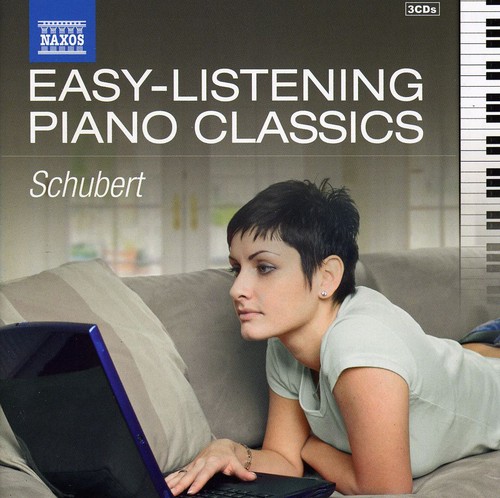
The son of a schoolmaster who had settled in Vienna, Franz Schubert (1797-1828) was educated as a chorister of the imperial court chapel and later qualified as a schoolteacher, briefly and thereafter intermittently joining his father in the classroom. He spent his life largely in Vienna, enjoying the company of friends, but never holding any position in the musical establishment or attracting the kind of patronage that Beethoven had twenty years earlier. While Schubert's work was admired by a close circle of friends and associates (including his teacher Antonio Salieri (1750-1825) and the prominent singer Johann Michael Vogl (1768-1840)) and some of his music was published during his lifetime, wider appreciation of his music was limited. Unable to secure adequate permanent employment, for most of his career he relied on the support of friends and family. Interest in Schubert's work increased dramatically in the decades following his death, not least through the advocacy of Robert Schumann (1810-1856), and he is now acclaimed as one of the greatest composers in the Western tradition. His final years were troubled by illness, as the result of a syphilitic infection, and he died in 1828, leaving much music unfinished. His gifts had been most notably expressed in song, but his talent for melody is always evident in his other compositions. As Leon Plantinga notes in Romantic Music: A History of Musical Style in Nineteenth-Century Europe: 'In his more than six hundred lieder he explored and expanded the potentialities of the genre as no composer before him.' These are notable for their highly-charged emotionalism, immeasurably enriched by Schubert's expressive and at times experimental harmonies, not merely in their vocal lines but, perhaps more importantly, in their eloquent piano parts which may both illustrate dramatic situations and reveal psychological undercurrents. Indeed, many of his songs found new life as piano transcriptions by such great composers as Franz Liszt (1811-1886), Johannes Brahms (1833-1897) and Sergei Rachmaninov (1873-1943). Schubert's development as a composer progressed rapidly throughout his tragically short life. While taking as his starting point the Classical style of Wolfgang Amadeus Mozart (1756-1791) and Ludwig van Beethoven (1770-1827), Schubert preferred spinning long-breathed Romantic melody rather than following the tightly argued harmonic drama of Classical sonata form; it's no coincidence that some of his best loved works are variations. He also explored other harmonic relationships than the tonic-dominant pivot typical of the Classical style, giving his music a subtlety and power that would prove important for the Romantic composers who followed him.
Check out these titles

petal
Ariana Grande

Doomnuts (purple Vinyl)
J Dilla & Mf Doom & J Villain
The Great Divide
Noah Kahan
Deadbeat
Tame Impala
Jolene
Dolly Parton

Visitor
Sienna Spiro

Foreign Tongues
The Rolling Stones
AIR Moon Safari - The Athens Concert
Air

Charm
Clairo
son of dad
Stephen Wilson Jr.

