1
Horn Concerto In E-Flat Major: I. Con Discretione
2
Horn Concerto In E-Flat Major: II. Adagio
3
Horn Concerto In E-Flat Major: III. Allegro
4
Horn Concerto In D Major, Twv 51:D8: I. Vivace
5
Horn Concerto In D Major, Twv 51:D8: II. Largo
6
Horn Concerto In D Major, Twv 51:D8: III. Allegro
7
Horn Concerto In E-Flat Major: I. Allegro
8
Horn Concerto In E-Flat Major: II. Largo
9
Horn Concerto In E-Flat Major: III. Vivace
10
Sinfonia Da Camera In D Major, Lmw VII:D5: I. Allegro Moderato
11
Sinfonia Da Camera In D Major, Lmw VII:D5: II. Menuet - Trio
12
Sinfonia Da Camera In D Major, Lmw VII:D5: III. Andante
13
Sinfonia Da Camera In D Major, Lmw VII:D5: IV. Allegro
14
Horn Concerto No. 1 In D Major, Hob. Viid:3: I. Allegro
15
Horn Concerto No. 1 In D Major, Hob. Viid:3: II. Adagio
16
Horn Concerto No. 1 In D Major, Hob. Viid:3: III. Allegro
Item UPC: 7318599923154
Date First Available:
Label: BIS
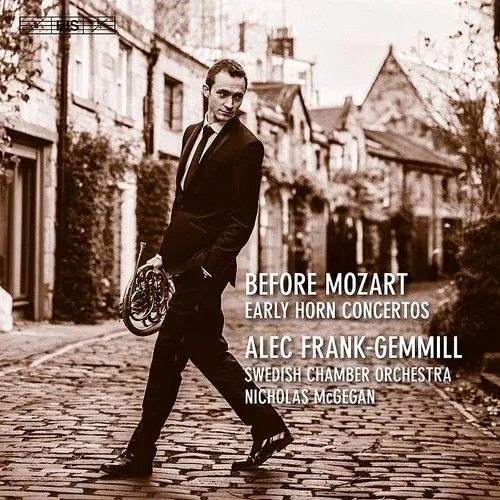
Alec Gemill Frank
Before Mozart / Early Horn Concertos
ABOUT THE ALBUM
Mozart's horn concertos are so well-known that for many listeners the sound of the horn and Mozart are virtually synonymous. Mozart was not the first composer to write solo concertos for the horn, however, and works from earlier on in the eighteenth century give a quite different perspective on the instrument. With this release soloist Alec Frank-Gemmill provides insights into some of these early horn concertos, by composers ranging from Telemann to Haydn, by way of Mozart's own father, Leopold. In the seventeenth century, when the horn first appeared in classical music, it was in the context of hunting scenes in operas by Lully, Cavalli and others. But the instrument's true adoption into art music really began the following century in the German-speaking world, where Dresden for a while became the most important centre for performing on, and composing for, the horn. Around 1750, both Christoph Förster and Johann Baptist Georg Neruda wrote extremely demanding and virtuosic concertos - Neruda's Concerto in E flat major is in such a high register that it has sometimes been assumed to be composed for the trumpet. Through modern innovations in horn design it is once more possible to perform all of these early horn concertos, including parts previously considered 'impossibly high'. Alec Frank-Gemmill is recognised internationally for the exceptional breadth and depth of his music-making. His interest in historical performance informed his previous, highly acclaimed release for BIS - a traversal of the horn repertoire throughout some 140 years, performed on four different 19th-century instruments. On the present album he plays on modern horns, but draws heavily on his familiarity with 18th-century horn technique and style, with the support of the Swedish Chamber Orchestra under period performance expert Nicholas McGegan.
Check out these titles
The Live Album
Neil Young and The Chrome Hearts
The Dark
Chelsea Wolfe
Charm
Clairo
Michael - O.S.T.
Michael Jackson
Doomnuts (purple Vinyl)
J Dilla & Mf Doom & J Villain
Reality Awaits
The Strokes
Survival & Other Stories
Jon Anderson
Siamese Dream (RSD Essential) -
Smashing Pumpkins
Embers to Ashes
Everlast
Born to Kill
Social Distortion