
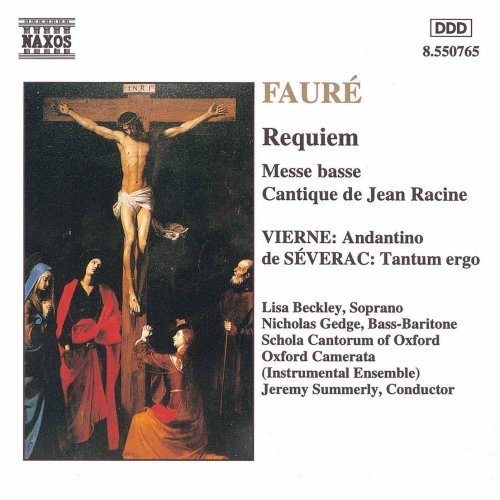
1
Gabriel Faure: Requiem: I. Introit Et Kyrie
2
II. Offertoire
3
III. Sanctus
4
IV. Pie Jesu
5
V. Agnus Dei
6
VI. Libera Me
7
VII. In Paradisum
8
Louis Vierne: Andantino
9
Deodat De Severac: Tantum Ergo
10
Gabriel Faure: Messe Basse: I. Kyrie
11
II. Sanctus
12
III. Benedictus
13
IV. Agnus Dei
14
Gabriel Faure: Cantique De Jean Racine, Op. 11
Item UPC: 730099576529
Date First Available:
Label: NAXOS
Requiem
Buying from Love Vinyl Records
CD
$18.90
$26.02 including shipping and handling (rates may vary)
Only in stock at this store!
ABOUT THE ALBUM
The appearance of Fauré's Requiem in the 1880s, a decade during which the composer's most successful compositions were songs and piano pieces, can on I y be explained by the fine choral music which preceded it. The Messe basse represents Fauré at his most practical. Written in conjunction with the French composer and organist André Messager (also at one time assistant to Widor at St Sulpice) during a holiday in Normandy in 1881, the Messe basse was composed for the modest forces of a local church. A setting of the motet O salutaris hostia and the Kyrie were Messager's contribution; the remaining movements of the Ordinary, without the Credo, were set by Fauré. When revising the score in 1906 Fauré adapted the violin and harmonium accompaniment for organ, at the same time excising the Gloria and replacing Messager's Kyrie with one of his own. The final version of the Messe basse is one of the few existing settings of the mass for female voices and organ. The youthful Cantique de Jean Racine dates from 1865 when Fauré was studying with Saint-Saëns at the Ecole Niedermeyer in Paris. The Cantique earned Fauré a premier prix in composition and is a testament to the young composer's melodic genius and to his penchant for rich textures. This recording is an attempt to move Fauré's liturgical music from the concert hall to the church. In particular, the reconstruction of nineteenth-century French ecclesiastical pronunciation and the restoration of Fauré's preferred phrasing are just two of the most useful elements in the search for the composer's intentions. To those familiar with the more expansive versions of Fauré's Requiem there will inevitably be unfamiliar textures in this performance. However, few of Fauré's romantic gestures are lost in the chamber version, and moreover, the reserved translucence of the instrumentation emphasizes the fact that the Requiem -and indeed all the choral music recorded here - was originally designed for liturgical performance.
Check out these titles
Lost Weekend
Phoebe Bridgers
Role Model Hermit
Mary In The Junkyard
Bass Persuades
Miley

The Jaws of Life
Pierce The Veil

Big Lizard in My Backyard
Dead Milkmen
Life Is Peachy - 30th Anniversary
Korn

Rockstar
Dolly Parton

This Place Will Become Your Tomb
Sleep Token
One Assassination Under God - Chapter 2
Marilyn Manson

Mutiny After Midnight
Johnny Blue Skies & the Dark Clouds