
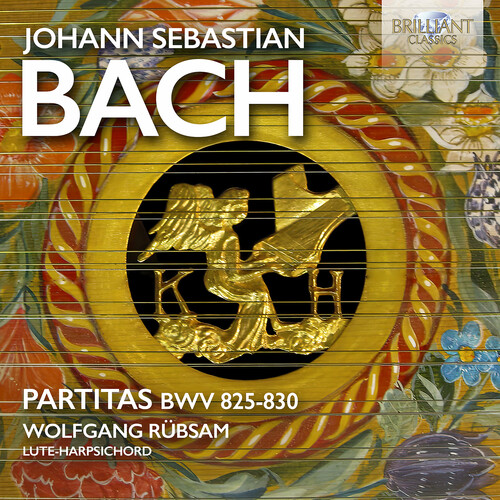
1
Partita No. 1 In B-Flat Major, Bwv 825: I. Praeludium
2
Partita No. 1 In B-Flat Major, Bwv 825: II. Allemande
3
Partita No. 1 In B-Flat Major, Bwv 825: III. Corrente
4
Partita No. 1 In B-Flat Major, Bwv 825: IV. Sarabande
5
Partita No. 1 In B-Flat Major, Bwv 825: V. Menuet I + II
6
Partita No. 1 In B-Flat Major, Bwv 825: VI. Gigue
7
Partita No. 2 In C Minor, Bwv 826: I. Sinfonia
8
Partita No. 2 In C Minor, Bwv 826: II. Allemande
9
Partita No. 2 In C Minor, Bwv 826: III. Corrente
10
Partita No. 2 In C Minor, Bwv 826: IV. Sarabande
11
Partita No. 2 In C Minor, Bwv 826: V. Rondeaux
12
Partita No. 2 In C Minor, Bwv 826: VI. Capriccio
13
Partita No. 3 In A Minor, Bwv 827: I. Fantasia
14
Partita No. 3 In A Minor, Bwv 827: II. Allemande
15
Partita No. 3 In A Minor, Bwv 827: III. Corrente
16
Partita No. 3 In A Minor, Bwv 827: IV. Sarabande
17
Partita No. 3 In A Minor, Bwv 827: V. Burlesca
18
Partita No. 3 In A Minor, Bwv 827: VI. Scherzo
19
Partita No. 3 In A Minor, Bwv 827: VII. Gigue
20
Partita No. 4 In D Major, Bwv 828: I. Ouverture
21
Partita No. 4 In D Major, Bwv 828: II. Allemande
22
Partita No. 4 In D Major, Bwv 828: III. Corrente
23
Partita No. 4 In D Major, Bwv 828: IV. Aria
24
Partita No. 4 In D Major, Bwv 828: V. Sarabande
25
Partita No. 4 In D Major, Bwv 828: VI. Menuet
26
Partita No. 4 In D Major, Bwv 828: VII. Gigue
27
Partita No. 5 In G Major, Bwv 829: I. Praeambulum
28
Partita No. 5 In G Major, Bwv 829: II. Allemande
29
Partita No. 5 In G Major, Bwv 829: III. Corrente
30
Partita No. 5 In G Major, Bwv 829: IV. Sarabande
31
Partita No. 5 In G Major, Bwv 829: V. Tempo Di Minuetta
32
Partita No. 5 In G Major, Bwv 829: VI. Passepied
33
Partita No. 5 In G Major, Bwv 829: VII. Gigue
34
Partita No. 6 In E Minor, Bwv 830: I. Toccata
35
Partita No. 6 In E Minor, Bwv 830: II. Allemande
36
Partita No. 6 In E Minor, Bwv 830: III. Corrente
37
Partita No. 6 In E Minor, Bwv 830: IV. Air
38
Partita No. 6 In E Minor, Bwv 830: V. Sarabande
39
Partita No. 6 In E Minor, Bwv 830: VI. Tempo Di Gavotte
40
Partita No. 6 In E Minor, Bwv 830: VII. Gigue
Item UPC: 5028421964645
Date First Available:
Label: BRILLIANT CLASSICS
ABOUT THE ALBUM
Playwright Luise Gottsched, née Kulmus, in 1732 wrote a letter to her future husband, the writer Johann Christoph Gottsched: 'The keyboard pieces sent over by Bach... are as difficult as they are beautiful. Even after playing them ten times, they still seem new to me.' A few years later polymath and Bach's former pupil Lorenz Christoph Mizler offered the following advice regarding these Clavier-Übung I partitas: 'Anyone who has difficulties with keyboard fingering will find it difficult to learn the keyboard pieces written by the famous Mr. Bach in Leipzig'. The name Sinfonia for the first movement in the Partita in C minor is redolent of opening cantata movements and the dotted rhythm of a French overture. The Grave adagio however, is not followed by the fugal fast section you would expect here. This approach was carried out more consistently and stylistically in the Partita in D major, although there the fast section approaches the form of a concerto. Instead, the Grave adagio of the Partita in C minor is followed by a sonata-like movement with an arabesque effect in the upper voice, followed by a lively fugato. As a result, the piece appears in three parts. In contrast, the opening Fantasia in the Partita in A minor is more akin to an invention, showing similarities with the opening section of the second English Suite of the same key. Moreover, since the 17th century, the distinction between the terms 'Praeludium' and 'Praeambulum' was insignificant. Yet Bach's delicately sculpted Praeludium in the B flat major Partita, is stylistically very different from the concerto-like Praeambulum of the Partita in G major. Lastly, the Toccata in the Partita in E minor offers rhapsodic-improvisatory sections framing a fugue after the style of Froberg, whose works for keyboard instruments must have been known to Bach.
Check out these titles

Doomnuts (purple Vinyl)
J Dilla & Mf Doom & J Villain
Bass Persuades
Miley

Reality Awaits
The Strokes

Reflections
From Ashes to New

hara-kiri(Deluxe) -
honestav

Everything's Falling
The Warning

The Age of Everything
Johnny Marr
Color Outside The Lines
Cortis

Homage
Tesla

Rockstar
Dolly Parton

