
1
Alla Guerra D'amore
2
Intenerite Voi, Lagrime Mie
3
Vorrei Baciarti, O Filli
4
Cruda Amarilli
5
O Primavera Gioventù Dell'anno
6
II. O Dolcezze Amarissime D'amore
7
III. Ma Se Le Mie Speranze Oggi Non Sono
8
IV. Qui Pur Vedrolla Al Suon De' Miei Sospiri
9
V. O Lungamente Sospirato Invano
10
La Mia Filli Crudel
11
Odi Quel Rosignolo Am
12
II. Mormora Seco
13
Vostro Fui, Vostro Son
14
Dove Potrò Mai Gir Tanto Lontano
15
Là, Tra 'l Sangue E Le Morti
16
Amico Hai Vinto
17
II. Poco Quindi Lontan Nel Sen Del Monte
18
III. Non Morì Già
19
Or Che Il Ciel E La Terra
20
Tu Mi Lasci O Cruda Bella
21
Occhi, Convien Morire
22
Com'è Soave Cosa
23
Donna, Siam Rei Di Morte
24
Occhi Della Mia Vita
Item UPC: 5028421956343
Date First Available:
Label: BRILLIANT CLASSICS
Ensemble Arte Musica
Musiche a Una E Due Voci
CD
ABOUT THE ALBUM
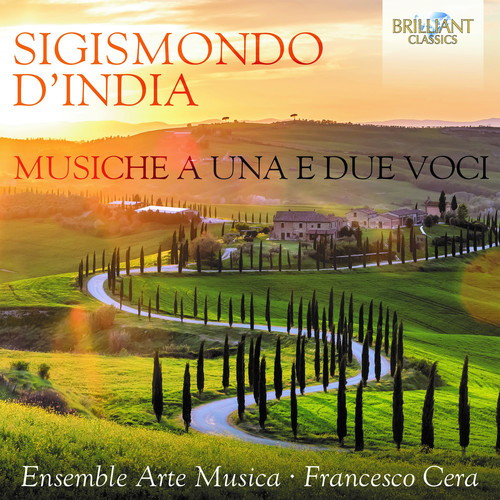
These songs for one and two voices come from the first four of D'India's five books of Musiche, a series containing masterpieces of astonishing originality in the style of monody (solo melody with accompaniment), which had eclipsed the polyphonic madrigal in popularity at the dawn of the 17th century. With a career based largely in Turin and Rome, Sigismondo D'India nevertheless demonstrates stylistic links to both Monteverdi and Gesualdo, and it is the latter's influence which supports new scholarship claiming D'India grew up in Naples (not Sicily) in the shadow of the great madrigalist's free thinking on harmony. That very harmonic freedom - to accentuate key emotions in the text with piquant chord changes - is the hallmark of D'India's own, self-styled 'true manner' of composing monody, adopted from Gesualdo's intense, chromatic polyphony to the solo song or duet, and it suggests a Neapolitan, rather than Roman-Florentine, musical background. In D'India's own words, he uses 'intervals out of the ordinary, moving with the greatest invention from one consonance to the next, depending on the variety of the meaning of the words' for 'greater impact and greater power to move the emotions of the soul'. It is this sense for the dramatic power of song that positions D'India as a true proto-operatic composer. In fact, his three-part setting of Clorinda's death scene from Tasso's Gerusalemme liberata (Amico hai vinto) predates by several years that of his contemporary Monteverdi: the revolutionary Il combattimento di Tancredi e Clorinda. Perhaps the young D'India's wide travels across Italy, absorbing the musical styles at each locale and acquiring a broad grasp of the varied stylistic practices throughout the peninsula in the early Baroque, gave him the conviction to claim his own style as the 'true manner'. In any case, it's originality and vision are truly remarkable.
Check out these titles
Live At Ted Askey's Pig Farm 1970
Grateful Dead
Live From the Los Angeles Sports Arena, April 26th, 1975
Pink Floyd

Mutiny After Midnight
Johnny Blue Skies & the Dark Clouds
Shapes Of Midnight
Uncle Acid & The Deadbeats
Wicked For Good: The Soundtrack (Original Soundtrack)
Wicked: For Good the Soundtrack / O.S.T.

Man's Best Friend
Sabrina Carpenter

The Boys of Dungeon Lane
Paul McCartney
Balance
Van Halen
Recovering the Satellites
Counting Crows
Willoughby Tucker, I'll Always Love You
Ethel Cain