
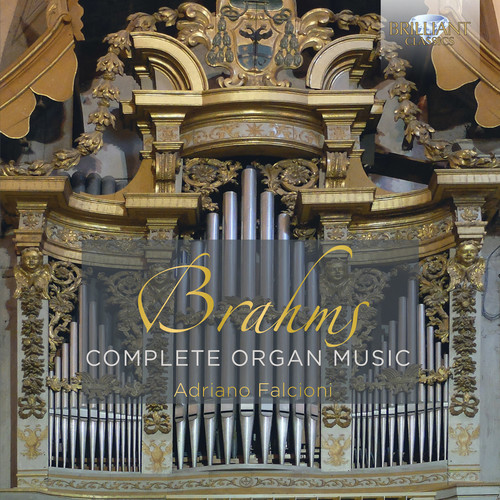
1
Prelude And Fugue In A Minor, Woo 9
2
Prelude And Fugue In G Minor, Woo 10
3
Fugue In A-Flat Minor, Woo 8
4
Chorale Prelude And Fugue On "O Traurigkeit, O Herzeleid" In A Minor, Woo 7
5
11 Chorale Preludes, Op. 122: I. Mein Jesu, Der Du Mich
6
11 Chorale Preludes, Op. 122: II. Herzliebster Jesu, Was Hast Du Verbrochen
7
11 Chorale Preludes, Op. 122: III. O Welt, Ich Muß Dich Lassen
8
11 Chorale Preludes, Op. 122: IV. Herzlich Tut Mich Erfreuen
9
11 Chorale Preludes, Op. 122: V. Schmücke Dich, O Liebe Seele
10
11 Chorale Preludes, Op. 122: VI. O Wie Selig Seid Ihr Doch, Ihr Frommen
11
11 Chorale Preludes, Op. 122: VII. O Gott, Du Frommer Gott
12
11 Chorale Preludes, Op. 122: VIII. Es Ist Ein Ros' Entsprungen
13
11 Chorale Preludes, Op. 122: IX. Herzlich Tut Mich Verlangen
14
11 Chorale Preludes, Op. 122: X. Herzlich Tut Mich Verlangen
15
11 Chorale Preludes, Op. 122: XI. O Welt, Ich Muß Dich Lassen
Item UPC: 5028421944609
Date First Available:
Label: BRLT
Complete Organ Music
Pick from
3 formats and editions
Starting at
CD
Unavailable
CD
Unavailable
CD
Unavailable
ABOUT THE ALBUM
Brahms made a fairly slender contribution to the organ literature when set beside his works for solo voices, for chamber ensembles and orchestra, and it is confined to the farthest extremes of his career as a composer. Several preludes and fugues from 1856-7, while Brahms was still in his early 20s and lately crowned by Robert Schumann as a savior for German music, the one true successor to Beethoven. He then wrote nothing for the instrument until the early summer of 1897, when he produced a set of 11 chorale preludes, designated them Op.122 and dedicated them to the memory of Schumann's wife Clara, who had died on 20 May that year, leaving the composer without his best and dearest friend. Nonetheless the two sets of works, so far apart in years, share several qualities: not least a polyphonic rigor borne of dedicated training, complete mastery of counterpoint and a reverence for the German Baroque and Renaissance in music which Brahms considered his artistic heritage as much as that by more recent predecessors such as Beethoven and Schumann. They also share with the sacred choral works such as the German Requiem a mood of humble devotion and great melodic beauty: whatever the context, Brahms knew how to write a tune. This new recording was made on the organ of the Cathedral of Amelia in Umbria, an instrument built by the Austrian firm of Rieger brothers in 1904 and comprehensively restored by Pietro Corna in 2014. The booklet prints a full organ specification as well as a history of the instrument, an explanation of Brahms's relationship with the organ and the original chorale texts on which the late Preludes are based. Built in the orchestral style of late-19th-century German organs, the instrument is ideally equipped to register the sombre poetry of Brahms's music.
Check out these titles
Frozen Charlotte
Jack White
The Age of Everything
Johnny Marr
A-Meow-Zing Music
Gabby's Dollhouse: The Movie / O.S.T.
TANZNEID
Electric Callboy
Maggot Brain - 2026 Reissue
Funkadelic

From A Distance
156/Silence
Look Outside Your Window
Look Outside Your Window

Ben
Macklemore
Preacher's Daughter
Ethel Cain
Live At Easy Street Records Vol II
Brandi Carlile

