
1
First of All 2:01
2
Perhaps the Principal Thing 1:39
3
Let Me Start 0:53
4
This Is Not Just a Sentimental Anecdote 1:52
5
From This Time 2:29
6
But How Do We Investigate 2:52
7
Now You Can See 1:29
8
Universality Is a Big Word 2:31
9
Other Linguists 2:46 1
10
I Began By Imagining Myself 2:12 1
11
Well, Then I Thought 2:06 1
12
Let's Make a Simple Analogy 2:03 1
13
Maybe Even a Divine One 1:33 1
14
But Where Do These Notes Come From? 2:22 1
15
This Acoustical Phenomenon 2:08 1
16
All These Upper Notes 1:52 1
17
The First Overtone 2:33 1
18
But More of That Later 1:56 1
19
But Let's Not Make the Mistake 2:21 2
20
And That's How the Tempered Clavichord 2:12 2
21
Now This Is a Substantive Universal 2:01 2
22
But Let's Be Careful 1:43 2
23
And There Is Always That Blue Note 1:30 2
24
But Even These Twelve Tones 1:57 2
25
I Trust You Realize 2:16 2
26
And Again Comes a Great Leap 2:32 2
27
Now This Means 1:38 2
28
This Is Not to Say That There Were No Drastic Changes 2:28 2
29
But Meanwhile We Are Still in the Golden Age 2:55 3
30
So, We're in the Midst of a Chromatic Adventure 1:28 3
31
And All By Those Progressions 1:34 3
32
Now, I Must Point Out 1:57 3
33
Do You Realize 1:34 3
34
I. Allegro Molto 8:18 3
35
II. Andante 8:31 3
36
III. Menuetto, Allegretto 4:36 3
37
IV. Finale. Allegro Assai 6:08 3
38
Every Once in a While 1:44 3
39
Last Week 2:24 4
40
Amen, Says Noam Chomsky 2:09 4
41
I Suppose What Chomsky Is Really After 2:49 4
42
So, Let's Pull Up Our Socks 1:36 4
43
All Right, Let's Try Another One 2:08 4
44
Why I Taking Your Time 2:11 4
45
Well Then 1:48 4
46
I Think It Follows 1:52 4
47
But First, What Are These Principles 1:49 4
48
Tranformational Grammar 1:36 4
49
But Now Just Think of That Sentence 1:02 5
50
Since This Is Not a Linguistics Class 1:49 5
51
Take the Passive Transformation 1:51 5
52
Well, It Hasn't Brought Us There 1:51 5
53
Good - Now Just As Three Notes Are Linked Together 1:44 5
54
Now Let's Go Back 1:49 5
55
Now We Are Ready 2:27 5
56
Now I Wanna Take You 2:05 5
57
Well, Transformation, Deletion, Embedding, Pronominalization 1:49 5
58
I Sure I Don't Have to Trouble 2:16 5
59
Here I Go 1:30 6
60
I Have Asked Myself 1:55 6
61
I Became So Fascinated 1:42 6
62
Let's Take One Such Utterance 2:00 6
63
Now Imagine 1:29 6
64
Now Let's See 2:32 6
65
Mozart's G Minor Symphony 1:21 6
66
Now Our Job Is 2:27 6
67
That Introductory Accompaniment 1:26 6
68
What Does This Three-Note Design Mean 1:55 6
69
The Reason I Pick Symmetry 2:13 7
70
Now from Here on 2:04 7
71
And Once Again, We Are Back 1:10 7
72
By Far the Chief Transformational Principle 1:42 7
73
You See, One of the Great Failings 1:58 7
74
Most People Hearing Mozart's Opening 1:46 7
75
So What Your Ask 1:59 7
76
And If You Are Still Not Convinced 2:32 7
77
Thesebiguities 1:20 7
78
For Instance, in This Same First Movement 1:59 7
79
So All These Syntactic Transformations of the Same Material 1:14 8
80
He Talks About This Sonnet 1:55 8
81
Because Now It's Time 1:35 8
82
But Now Let's Listen to 2:09 8
83
Listen to the Whole Exposition 2:03 8
84
Development Coming Up 2:08 8
85
The Circle of Fifths Again 2:02 8
86
And That Was All One Single Sentence 1:18 8
87
The Other Day 2:37 8
88
The First Would Show Us One Meaning 1:13 8
89
Think of This Famous Passage 2:23 9
90
A Linguist Would Say 1:52 9
91
Well, I Replied, Chomsky Would Say 2:06 9
92
Of Course, That Last Metaphorical Leap 1:50 9
93
Terrific, Said My Blonde Inquisitor 1:44 9
94
In Fact, When You Think of the Number 2:16 9
95
All Right, First Let's Look Briefly 2:41 9
96
Playing, That's the Word 1:48 9
97
But Does This Stravinskian Game Concept 2:31 9
98
There Are Three Specific Ways 2:03 9
99
Now, Having Defined My Usages of Metaphor 1:59 10
100
And Here We Are in Trouble 1:06 10
101
Are We Feeling What Beethoven Supposedly Felt 1:45 10
102
We Will Never Know 2:22 10
103
Now, If We Accept This General Idea 1:40 10
104
In Our Last Lecture 1:47 10
105
We All Recognize Antithesis 1:46 10
106
It Can and It Does 1:24 10
107
And Again, As in the Poem 2:14 10
108
In Fact, It Has Been Authoritatively Suggested 2:45 10
109
We Can Expand the Idea 2:52 11
110
What Do You Suppose 2:51 11
111
What' Seriously Striking 2:16 11
112
So Why the Pastorale on This Lecture 2:42 11
113
Let's Begin at the Beginning 1:41 11
114
But What of the More Obvious Melodic Material 1:48 11
115
But to Develop How 2:37 11
116
Now We Have An Insight 2:13 11
117
But Wait 1:52 11
118
But Why Were Just Those Two Notes Added 2:05 11
119
The Metaphor Arises 2:48 12
120
But in the Ensuing Four Bars 2:11 12
121
But That's Not the Main Event 2:04 12
122
Well, That's the Beginning 1:58 12
123
That's One of the Questions 2:00 12
124
This Interference of the Two Frequencies 2:04 12
125
But What Are We to Say 1:40 12
126
It Is to Be Found 1:39 12
127
Now That's One Way of Looking 2:03 12
128
At This Point 1:36 12
129
Even If You Can Succeed 2:42 13
130
I. Erwachen Heiterer Empfindungen Bei Der Ankunft Auf Dem Lande. Allegro Ma Non Troppo 11:05 13
131
II. Scene Bach. Andante Molto Moto 13:42 13
132
III. Lustiges Zusammensein Der Landleute. Allegro 5:27 13
133
IV. Gewitter. Sturm. Allegro 3:43 13
134
V. Hirtengesang. Frohe Und Dankbare Gefühle Nach Dem Sturm. Allegretto 10:13 13
135
When I First Wrote Down the Title 1:41 13
136
Part of the Danger 2:02 13
137
The Idea Ofbiguity 1:32 13
138
Similarly, in Our Second Lecture 2:05 13
139
Then What's the Magic Secret 2:53 14
140
Enough Ofbiguity 1:52 14
141
The Irony of All This 2:07 14
142
But, Mind You 1:53 14
143
Where Music Was Concerned 1:29 14
144
Only Think of 1:58 14
145
And Chopin Well We Can't Ignore Chopin 2:53 14
146
And Then, in the Same Little Mazurka 1:57 14
147
Foolish Questions 1:33 14
148
Let Me Try to Read You 1:56 14
149
Listen to This 1:45 15
150
They Began to Intermingle 1:30 15
151
The Pivotal Point 1:39 15
152
So There Is a Dramatic Change 1:50 15
153
So It Is After All Not So Surprising 2:31 15
154
Now If You Noticed 1:40 15
155
You See, the Music Is Trying Hard 1:44 15
156
So That Instant in Musical Time 1:33 15
157
Now Romeo Is All Stirred Up 3:00 15
158
. Romeo Seul Tristesse - Bruits de Concerts Et de Bal - Grand Fete Chez Capulet Andante Malinconico E Sostenuto 4:28 15
159
Allegro - Larghetto Espressivo - (Instrumental) 1:57 16
160
Allegro - (Instrumental) 2:22 16
161
Reunion Des Duex Themes, Du Larghetto Et de L'allegro (Instrumental) 3:42 16
162
What a Piece 2:30 16
163
Quite Unconsciously Borrowed 1:50 16
164
My Purpose in All This 2:25 16
165
Is It, Says Wagner 2:16 16
166
Every Diminished Seventh Chord 1:23 16
167
Now the Remarkable Thing Is 2:54 16
168
And This Is What Gives Tristan 2:53 16
169
Prelude and Love-Death (From 'Tristan and Isolde') 19:03 17
170
:00:00 PM 17
171
That May Be the Slowest Performance 2:26 17
172
But Ultimately 1:38 17
173
Poetry Has Begun to Show 1:40 17
174
And When Debussy 1:37 17
175
It's Lovely, This Dreaming 2:35 17
176
For Example, Do You Remember 1:45 17
177
In Fact, the Ending of This Piece 1:17 17
178
Let Me Show You Briefly 2:07 17
179
This New Episode That Proceeds 1:24 18
180
For Instance, Hardly Have We Had Time 2:29 18
181
Because the Scale 1:53 18
182
It's Almost Exactly What Happens 1:51 18
183
Literally Translated 1:35 18
184
But Notice, Too, That the Example 1:34 18
185
Both Works Have Definitive Beginnings 1:32 18
186
Listen As I Play 1:49 18
187
Prelude a L'apres-Midi D'un Faune, L. - Remastered 10:24 18
188
Some Crazy Modern Music 1:04 18
189
Our Lecture Tonight 0:18 19
190
Rhapsodie Espagnole, M. IV. Feria 6:29 19
191
What a Way to Enter the Twentieth Century 1:38 19
192
But, If the Truth to Be Told 1:28 19
193
These Troubling Presentiments 2:18 19
194
So, Now in 2:12 19
195
This Is Atonality 2:30 19
196
A Charming Idea 0:28 19
197
The Unanswered Question 5:23 19
198
I That Luminous Final Triad 2:16 19
199
I Have Recently Been Reading 1:59 20
200
We Have Already Referred to Some of Those 3:02 20
201
In Any Case 1:57 20
202
But for All These Reasons 2:46 20
203
Son of Tristan 2:31 20
204
Now You Look at Those First Two Bars 2:20 20
205
Of Course, There Are Lots 1:57 20
206
It's As Though a New Covenant 1:40 20
207
Trouble Is, That the New Musical Rules 2:22 20
208
The Kind of Tonal Feeling 2:53 20
209
Of Course, There Are Those Who Say 1:39 210.
Item UPC: 190758504728
Date First Available:
Label: SYNX
ABOUT THE ALBUM
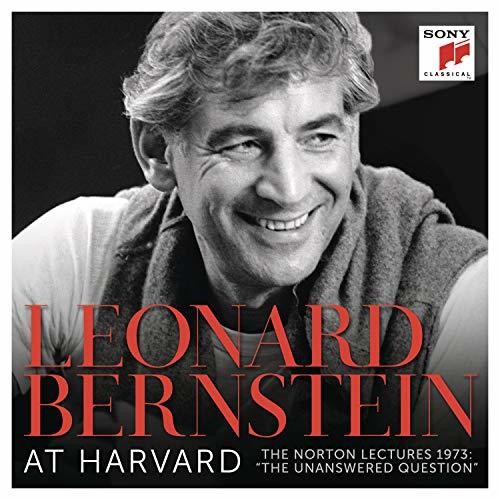
Leonard Bernstein was invited to become the Charles Eliot Norton Professor of Poetry at Harvard University, Cambridge in 1971. The professorship required Bernstein to live on campus for one school year, counsel students and, most significantly, deliver of a series of six public lectures. Bernstein, a "Harvard man" himself, was pleased and honored to become a part of this distinguished tradition. Bernstein began his residency at Harvard in the fall of 1972. He immersed himself in the academic culture with enthusiasm, and his popularity with students resulted in his being named "Man of the Year" by Harvard's student newspaper. Because the lectures embraced such a wide variety of disciplines, Bernstein faced the challenge of organizing his ideas into a coherent progression of six talks. Also, every word had to be written out and memorized because each of the lectures was to be presented twice: live at the University at the Harvard Square Theater, Cambridge, and then in a subsequent taping session for television at the WGBH TV Studios, Boston. Bernstein based much of the lectures on the linguistic theories Noam Chomsky set out in his book, "Language and Mind." In the first three lectures, Bernstein analyzed music in linguistic terms phonology (sound), syntax (structure) and semantics (meaning)-focusing on music from the Classical period. In the fourth lecture ("The Delights and Dangers of Ambiguity"), Bernstein looked at music from the Romantic period, with it's heightened harmonic uncertainties and structural freedoms. The fifth lecture ("The Twentieth Century Crisis") outlined the movement toward atonality and the crisis provoked by this crucial change in our musical language. Charles Ives' "The Unanswered Question," one of the primary musical examples, became Bernstein's title for the entire series of lectures. The final lecture ("The Poetry of the Earth") concentrated on the work of Igor Stravinsky, whom Bernstein thought had found a musical answer to "the unanswered question," one that kept tonality at it's center. The series ended with Bernstein's artistic and philosophical "credo," an essentially optimistic and celebratory statement of beliefs. Although the very breadth of the lectures attracted some negative criticism, they were also widely recognized as an impressive achievement. Lavishly multi-disciplinary long before it was fashionable, they provided a fresh way to analyze music and interpret musical history. The Norton Lectures stand as a special monument in Bernstein's legacy.
Check out these titles
Role Model Hermit
Mary In The Junkyard

A-Meow-Zing Music
Gabby's Dollhouse: The Movie / O.S.T.
Deadbeat
Tame Impala

Live At Easy Street Records Vol II
Brandi Carlile

Marrow Deep
Mastodon
Happier Now
Movements
Ow Infinity
Sylvan Esso
Shapes Of Midnight
Uncle Acid & The Deadbeats

The Dark
Chelsea Wolfe

I'm Ready
Tevin Campbell

