
1
I. Allegro di molto [07:09]
2
II. Andante [04:30]
3
III. Prestissimo [05:35]
4
I. Allegro di molto [09:25]
5
II. Andante [06:36]
6
III. Allegretto [06:19]
7
I. Allegro [08:08]
8
II. Larghetto [03:41]
9
III. Presto [05:09]
10
I. Allegro assai [04:12]
11
II. Poco adagio [02:11]
12
III. Tempo di minuetto [03:30]
13
IV. Allegro assai [05:31]
14
I. Adagio - Presto [06: 33]
15
II. Adagio [02:24]
16
III. Allegro [05:32]
17
I. Allegro di molto [08:27]
18
II. Larghetto [03:51]
19
III. Allegro [07:27]
Item UPC: 5028421955841
Date First Available:
Label: BRILLIANT CLASSICS
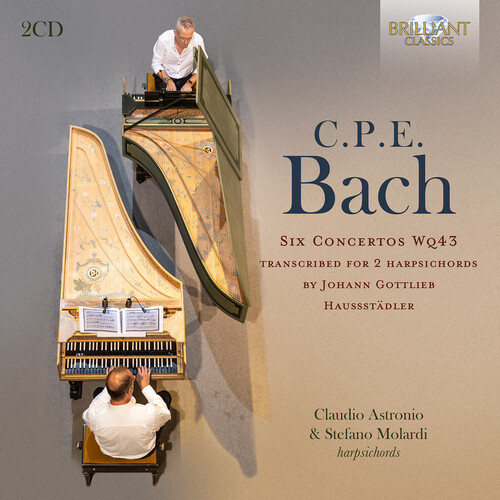
C Bach .F.E.
Six Concertos, Wq43 Transcribed For 2 Harpsichords
CD
ABOUT THE ALBUM
Carl Philipp Emanuel Bach wrote this set of six keyboard concertos Wq43 once he had been released from the constricting service to Frederick the Great of Prussia. He moved from Potsdam to Hamburg, and began composing there with new-found freedom. Published in 1772, these concertos are among the first-fruits of such liberated imagination. CPE designated them as 'six easy harpsichord concertos', with the same 'Liebhaber' in mind as the cultivated amateur audience for some of his keyboard sonatas. Nonetheless, the solo parts of these works will test the mettle of any aspiring or proven virtuoso. Their greatest originality, though, lies in their form. Each concerto is written cyclically, or continuously, meaning that one movement leads directly into the next. Even the cadenzas are fully written out, anticipating in this regard Beethoven's 'Emperor' Concerto of two generations later. While tautly disciplined in this way, the concertos are also full of CPE's flights of fancy: nowhere more so than the No. 4, in which the initial Allegro suddenly veers into an Adagio episode, and just as abruptly transforms into a Minuet. A cadenza unites the themes of all three movements or episodes before a final reprise of the Allegro: unprecedented, even for CPE. The panoply of CPE's instrumentation is necessarily compressed by this transcription of the concertos for two harpsichords, but the vitality of dialogue is fully preserved. It was made (or at least copied) by Johann Gottlieb Haußstädler, a copyist working for Peter August, the organist for the Elector of Saxony. The two men may have collaborated on the arrangement; at any rate, it has been unknown until now, and comes to life in the hands of a pair of Italian musicians with a serious pedigree in recording music of this period for Brilliant Classics
Check out these titles
Vivaldi: Piccolo Cons
Francesco Guggiola
Songs From A Stolen Guitar
Simon Joyner
Watercress
S. Carey
Sing the Delta
Iris DeMent

All We Know Is Falling
Paramore
Unplugged
Kensington
Ladies and Gentlemen: Best Of
George Michael
Instigate To Annihilate
Disquiet
Dialogue (Uk)
Howard Jones
Birthmarks
Born Ruffians